
Is the 1986 Quarter Worth Saving? A Practical Collector’s Perspective
If one is interested in the 1986 quarter, then it can still be easily found in change, drawers, and old coin jars. Because the date is no longer recent, people often stop and wonder about the 1986 quarter value and if they should keep or spend this one.
The question is practical. Some coins from the same period already show collector interest. Others remain ordinary. The difference is not always obvious at first glance. So, let us check what affects the quarter’s price today and when saving the coin makes sense.
General Overview of the 1986 Washington Quarter
The 1986 quarter belongs to the long-running Washington quarter series. The obverse shows George Washington. The reverse displays the eagle, used before the state quarter program began.
Coins dated 1986 were struck for circulation only. There were no special collector releases. Production took place at two mints: Philadelphia and Denver. Both produced issues in large numbers.
Most examples remained have severe signs of wear, but they are less common. Circulated coins dominate the market, but uncirculated ones are rare.
Basic Specifications and Identification
Correct identification always comes first. The 1986 quarter follows standard specifications used for decades.
Basic specifications:
Year: 1986
Denomination: Quarter dollar
Composition: Copper-nickel clad
Weight: 5.67 grams
Diameter: 24.26 mm
Edge: Reeded
Obverse: George Washington
Reverse: Eagle
Intended use: General circulation
As you see, the metal content explains another key point. The 1986 quarter contains no silver. This explains that there is no melt value above the face value. Any premium must come from condition, not metal.
What Makes People Save Modern Quarters
Many people save coins from the 1980s for simple reasons. The date looks old. The coin feels different from the current change. Some remember using these coins decades ago.
Another reason is confusion about which coins qualify as coins worth money. Online listings often blur the line between common circulation pieces and true collectibles.
Saving a coin does not always mean it has market value. In many cases, saving reflects curiosity or nostalgia. Collectors separate emotion from price.
The 1986 quarter sits in that middle zone. It is old enough to attract attention but common enough to require careful evaluation.
Condition First: When a 1986 Quarter Is Worth Keeping
Condition drives value more than any other factor. This rule applies fully to the 1986 quarter.
Most circulated examples show wear in predictable areas:
Washington’s cheek and jaw
Hair detail above the ear
Lettering near the rim
Feathers on the eagle
Wear appears first on raised surfaces. Flat areas expand as circulation continues. Letters and dates often remain readable longer.
Collectors must also distinguish between three issues:
Circulation wear
Weak strike
Post-mint damage
Wear creates smooth, even surfaces. Weak strikes show flat details with normal texture. Damage looks irregular, and scratches, dents, or cuts fall into this category.
Confusing these factors leads to overestimation: remember that many soft details come from use, not mint errors.
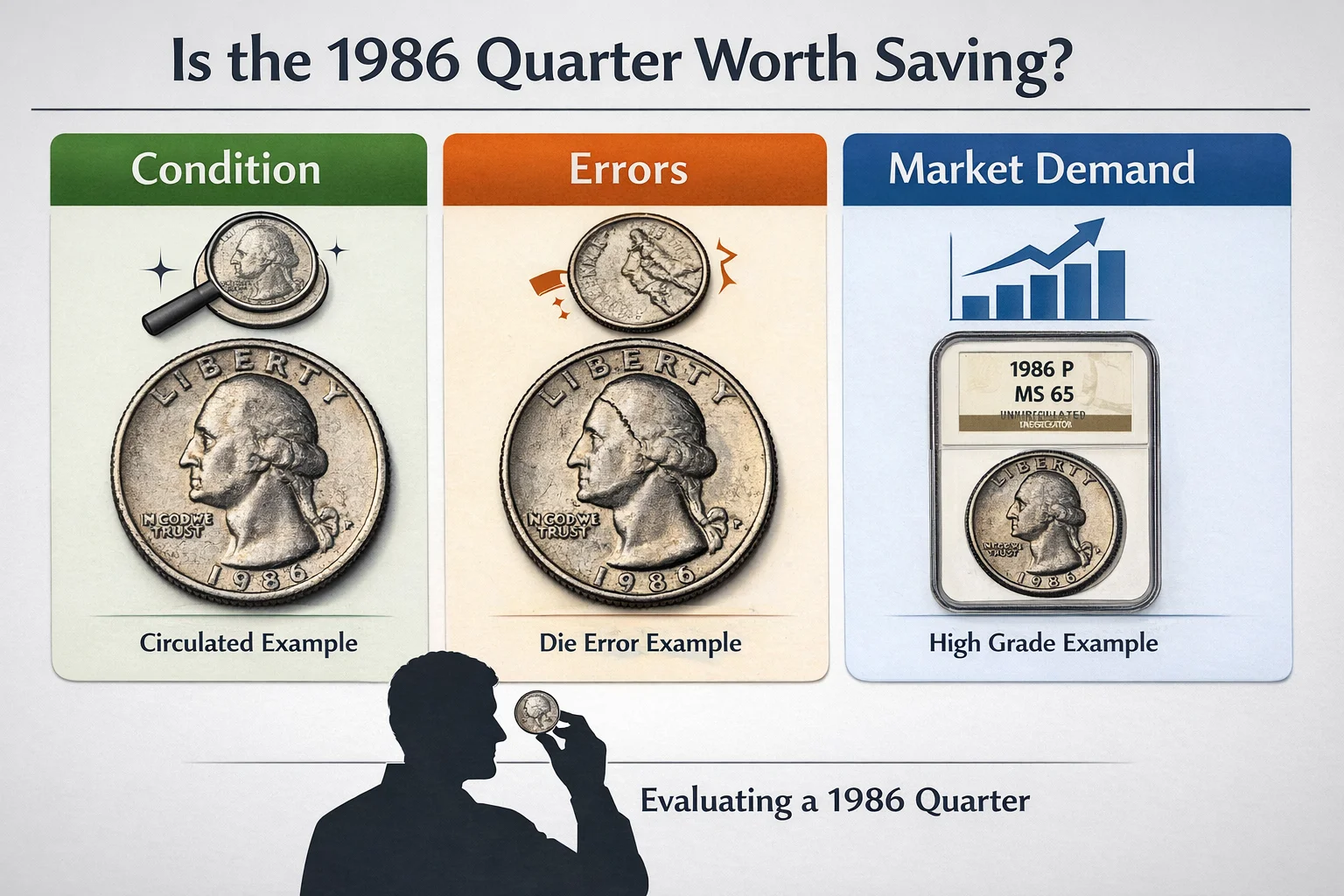
Minting Errors: When a 1986 Quarter Deserves Extra Attention
Most 1986 quarters are standard circulation coins. Still, some pieces show minting errors that can affect value.
Errors should be clear and verifiable. Minor wear or damage is not an error. Collectors look for defects caused during production, not after the coin entered circulation.
Below you can see the most common error types seen on 1986 quarters, with a short explanation and typical market ranges.
Error type | What it looks like | Typical price range |
Doubled Die Obverse / Reverse (1986-P / 1986-D) | Visible doubling on letters such as LIBERTY or on the date | $25–$150+ |
Filled Mint Mark (1986-P) | Mint mark appears weak, blob-like, or partly missing due to grease | $10–$40 |
Struck Through Grease (1986-P) | Missing or soft details where grease blocked the die | $15–$60 |
Misaligned or Doubled Mint Mark (1986-D) | “D” appears doubled or shifted | $20–$80 |
Die Cud / Die Break | Raised metal along the rim or near devices | $30–$150 |
Missing Letters or Design Details (1986-P) | Parts of the motto or reverse details are absent | $20–$100 |
Prices vary by clarity, eye appeal, and demand. Minor or unclear defects usually carry little premium. Strong, well-defined errors attract consistent interest.
For most collectors, errors are the only reason a circulated 1986 quarter moves beyond face value. Without them, condition remains the deciding factor.
Circulated vs Uncirculated: A Practical Comparison
Most 1986 quarters found today are circulated. They show dull surfaces and reduced detail. These coins usually stay close to face value.
Uncirculated examples look different. They retain original luster. High points remain sharp. Contact marks may appear, but wear does not.
Collectors prefer uncirculated coins because the supply drops sharply at higher grades. Fewer coins survive without wear.
That difference explains most price gaps. A clean, uncirculated quarter may sell for several dollars. A worn piece often trades at face value.
Saving a circulated 1986 quarter rarely makes financial sense. Saving a clean example can.
Market Value Overview
Prices below show the typical market value (without error examples).
Grade | Condition description | Typical price range |
Circulated | Heavy to moderate wear | Face value |
AU | Light wear, some luster | $1–$2 |
MS60–MS63 | Uncirculated, contact marks | $3–$6 |
MS64–MS65 | Strong strike, good luster | $8–$20 |
Market prices change over time. Demand stays steady, not speculative. Small visual differences matter most in higher grades.
A jump from MS65 to MS66 can double the value. Eye appeal becomes critical at that level. Very few coins qualify.
Common Mistakes When Deciding to Save a 1986 Quarter
Many mistakes come from expectations, not facts.
One common error is assuming age creates value. The 1986 quarter is old, but the supply remains high.
Another mistake is saving worn coins in hopes they will gain value later. Heavy wear limits demand. The condition does not improve with time.
Some confuse weak strikes with rarity. Flat details often come from normal production or circulation, not special varieties.
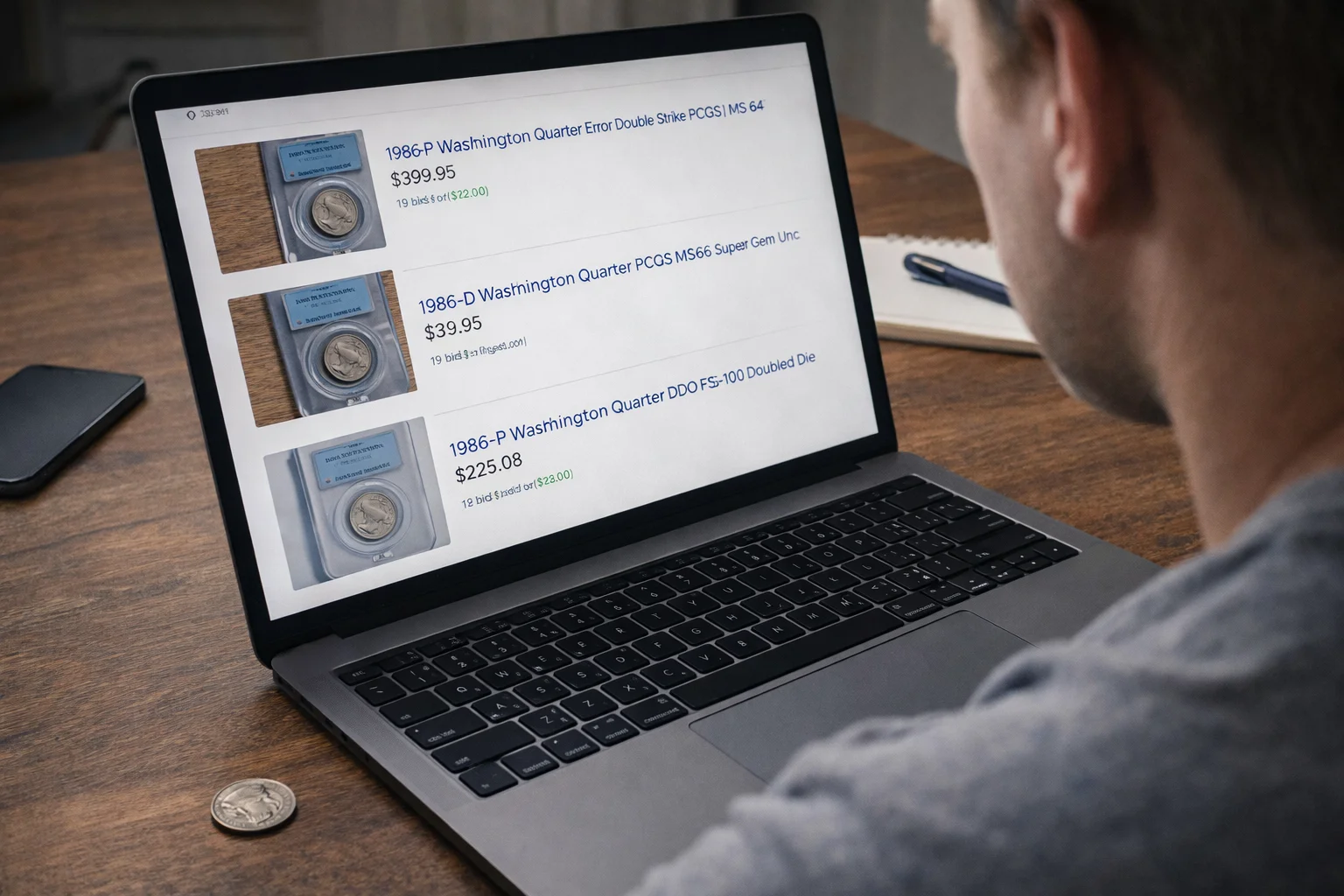
Others rely too much on online prices without checking the condition. Listings often show best-case examples.
Tools That Help Evaluate a Coin
Reference tools help with identification and organization, but they do not replace visual judgment.
Coin ID Scanner can assist with confirming the year, type, and basic specifications. It also helps store notes and compare estimated values. Use this best coin value app as a starting point, but also rely on your own opinion about condition, demand, and eye appeal to grade and estimate the quarter or any other coin accurately.
Final Points: When Saving a 1986 Quarter Makes Sense
Saving a 1986 quarter makes sense in limited cases: if the coin is uncirculated or when its is uused for study or grading practice.
Saving heavily worn examples rarely pays off: storage and grading are worth money, which may not pay off when the coin is sold. Thus, keep this coin as just a learning tool, not an investment.